
The short answer.
- Compare four arrangements: an open family room, a divided apartment, a named connecting product, and two ordinary rooms.
- Two separately booked rooms do not guarantee adjacency or an internal connection.
- For younger children, settle the permitted adult-and-child allocation and supervision plan before price sorting.
A property example for this guide.
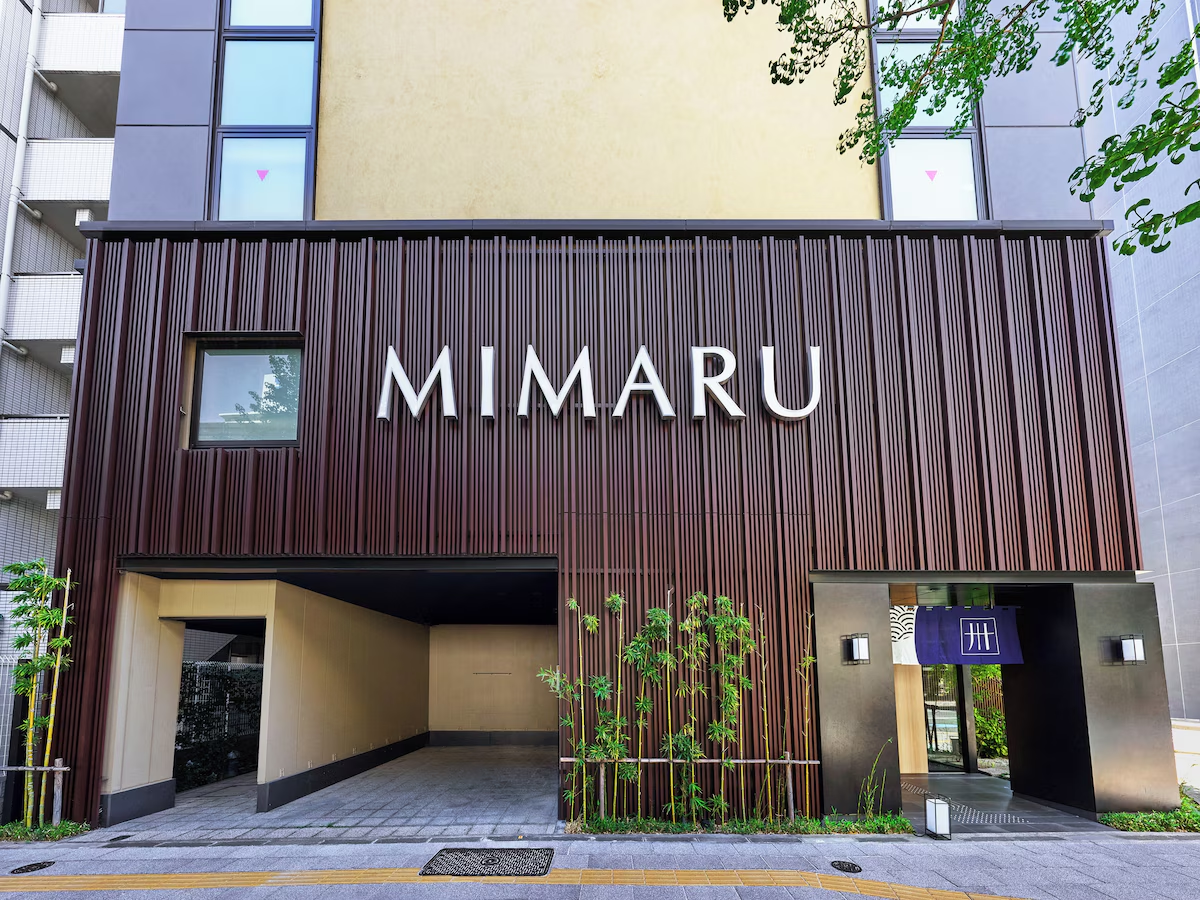
MIMARU Tokyo Ueno East is one of the room profiles linked below. This photo shows the property, not a verified room layout or equipment.
A family room and a family unit are different ideas
The most useful question is where everyone sleeps, where the adults can spend time after bedtime, and how the family reaches the bathroom and front door. An open apartment can be one shared space; a two-bedroom suite can keep everyone inside one unit with bedroom doors; two ordinary hotel rooms may place the group across a corridor.
Choose the arrangement before comparing headline rates. If every option is labelled simply “four people,” you lose the differences that matter in the morning and evening. A room with four acceptable beds can still fail your need for privacy, supervision or two independently usable bathrooms. Conversely, a bigger floor area may add little value when you will barely use it.
Four arrangements to compare separately
Use the table to identify what the reservation must actually include. “Connecting” is a physical relationship between rooms, while “adjacent” means next to each other without necessarily having an internal door. Two bookings in the same property are the least specific arrangement.
MIMARU’s official FAQ says some locations sell a Connecting Room type comprising two standard rooms joined by an internal door. It separately says requests to place two rooms next to each other may not be accommodated. That is a concrete reason to distinguish a named product from a request.
| Arrangement | Main practical benefit | Main limitation to resolve |
|---|---|---|
| One open family apartment | Everyone shares one unit; no corridor between sleepers | No separate sleeping room unless the floor plan shows one |
| One two-bedroom apartment | Bedroom separation inside a shared unit | Bedroom count does not establish toilet count or bed type |
| Named connecting-room product | Two rooms linked by an internal door | Exact capacity, bedding and connection must be part of the offer |
| Two ordinary rooms | Potential separation and two sets of room facilities | Placement may be only a request; confirm allocation and supervision |
Published facts: MIMARU FAQ: connecting products versus adjacency requests
A published suite shows why bathroom labels matter
MIMARU SUITES Tokyo Asakusa’s Two-Bedroom Suite lists four single beds in 60 m², two washbasins, one restroom, one bathroom and one shower room. That is useful detail: two bedrooms and two washing spaces do not mean two toilets. The property also has other suite categories with different inventories, so keep the exact category beside the numbers.
For a family that wants to wash in parallel but is comfortable sharing a toilet, this layout deserves a look. For a group that specifically needs two toilets, it does not pass that requirement. Two ordinary rooms may provide the desired separation, but only if each booked room’s facilities confirm it. Do not use “two bathrooms” as shorthand for equipment the source does not actually list.
Published facts: MIMARU SUITES Tokyo Asakusa: bedrooms and bathroom inventory
Test adult allocation before booking two rooms
Write the guests assigned to each room in plain language, including the children’s ages. A plan with one parent and one child per room may feel very different from a plan with both parents in one room and both children elsewhere. Confirm the property’s permitted arrangement rather than relying on an adult-only quote for each twin room.
If ordinary rooms must be next to each other for your plan to work, an unconfirmed request is a booking risk. Ask whether the required placement can be guaranteed under the selected rate, or choose a named connecting product or one suitable unit. Do not create two restrictive reservations before settling the condition that makes them usable.
Published facts: MIMARU FAQ: connecting products versus adjacency requests
Worked budget: compare the whole stay
Hypothetical example for four nights: a family unit has a quoted accommodation total of ¥200,000. Two ordinary rooms each have a total of ¥120,000, producing ¥240,000 combined. The accommodation difference is ¥40,000 for the stay, or ¥10,000 per night. These numbers are invented to demonstrate the worksheet; they are not Tokyo market prices or live hotel offers.
Now add only confirmed differences. If one option’s breakfast total is additional, put it on a separate line for the guests it covers. Add any required extra bedding or displayed compulsory charges. A fee that is already included in the checkout total must not be added again. If the options are at different hotels, compare a confirmed arrival-transfer difference separately.
Finally, ask what you obtain for the extra ¥40,000. It might be two independently usable toilets and more privacy, or merely uncertain room placement. If the cheaper one-unit option already meets the family’s sleep and bathroom needs, the extra cost may buy little you use. If it fails an essential requirement, the saving is irrelevant.
| Line | One family unit | Two ordinary rooms |
|---|---|---|
| Accommodation total | ¥200,000 | ¥120,000 + ¥120,000 = ¥240,000 |
| Confirmed meals or bedding | Enter only additional confirmed amounts | Add confirmed amounts for both rooms |
| Full payable comparison | Accommodation + additional charges | Both accommodation totals + additional charges |
| Placement condition | One booked unit | Record guaranteed placement or unresolved request |
| Cancellation exposure | One set of offer conditions | Read both offers and their deadlines |
Run an evening and departure-morning test
Hypothetical family A has children who go to sleep at the same time and is happy to read quietly in the shared room. An open four-bed apartment may be sufficient. Hypothetical family B has one early sleeper and a teenager who wants to talk or watch something later; a two-bedroom layout with a common area is a more relevant shortlist. These are routine-based choices, not a claim that one property is quieter.
For both families, draw the bathroom route and luggage positions on the published floor plan. Can someone reach the toilet without entering the other sleeping space? Where will four open suitcases go on departure morning? With two ordinary rooms, decide where the family will meet and who checks each room before leaving. This practical test often exposes an awkward arrangement that bed counts alone miss.
Align the rate conditions and booking records
Two rooms can carry different cancellation deadlines, prepayment rules or meal inclusions even when they are in the same hotel. Compare matched conditions where possible, and keep mixed conditions visible. Record the currency, full amount, room category and guest allocation for both reservations; a single per-night figure is an incomplete record.
Before payment, repeat the required arrangement in a concise question to the property: “For our stated party and dates, is this exact product one unit, two internally connected rooms, or two separate rooms, and what placement is guaranteed?” Save the reply with the offer. After booking, check every confirmation rather than assuming the second room copied the first room’s details.
A practical order for the final choice
Eliminate layouts that fail supervision, occupancy or essential bedding first. Then eliminate unconfirmed connections when a connection is essential. Only after those checks compare the payable totals and the conveniences your family will use. The goal is a complete arrangement that works if the hotel delivers exactly what the written offer promises.
The linked room profiles below help inspect specific categories, including an open four-single-bed apartment and a mixed-bedding apartment with private laundry. Use the official suite source for the divided-unit example. None of these examples establishes availability for your dates; they give you concrete layouts against which to compare the live offers.
- Name all guests and assign a sleeping place in every option.
- Separate bedroom count, toilet count and washing spaces.
- Confirm whether room placement is guaranteed or requested.
- Compare both complete bills and both cancellation conditions.
- Keep the layout and the property reply with the reservation.
Questions families ask.
Are two rooms usually cheaper than one family room?
There is no fixed result. Compare the same dates, party details, rate conditions and full payable totals. Two headline rates without meals, bedding and placement conditions do not settle the comparison.
Can I guarantee connecting rooms by asking in the booking notes?
A request alone does not establish a guarantee. Look for a named connecting-room product or an explicit confirmation covering the selected reservation and dates.
Does a two-bedroom suite have two toilets?
Not automatically. The checked Two-Bedroom Suite at MIMARU SUITES Tokyo Asakusa lists one restroom, despite two bedrooms and separate bathing and shower facilities. Inspect the exact inventory.
Sources and scope.
- MIMARU FAQ: connecting products versus adjacency requests
- MIMARU SUITES Tokyo Asakusa: bedrooms and bathroom inventory
- MIMARU Tokyo Ueno East: open four-single-bed example
- MONday Apart Ueno Shin Okachimachi: mixed-bedding apartment example
Hotel and transport conditions can change. This is a planning guide based on published information, not a promise of availability or a report of a personal hotel stay.
Ready to choose a room?
Compare our researched room profiles, then check your dates and guest ages on the booking page.