
The short answer.
- Match Keikyu or the monorail to the hotel’s useful arrival station and operator.
- A late arrival needs a usable onward connection and separate hotel check-in instructions.
- Compare fares for the whole party and verify vehicle capacity, seats, pickup and charges.
A property example for this guide.
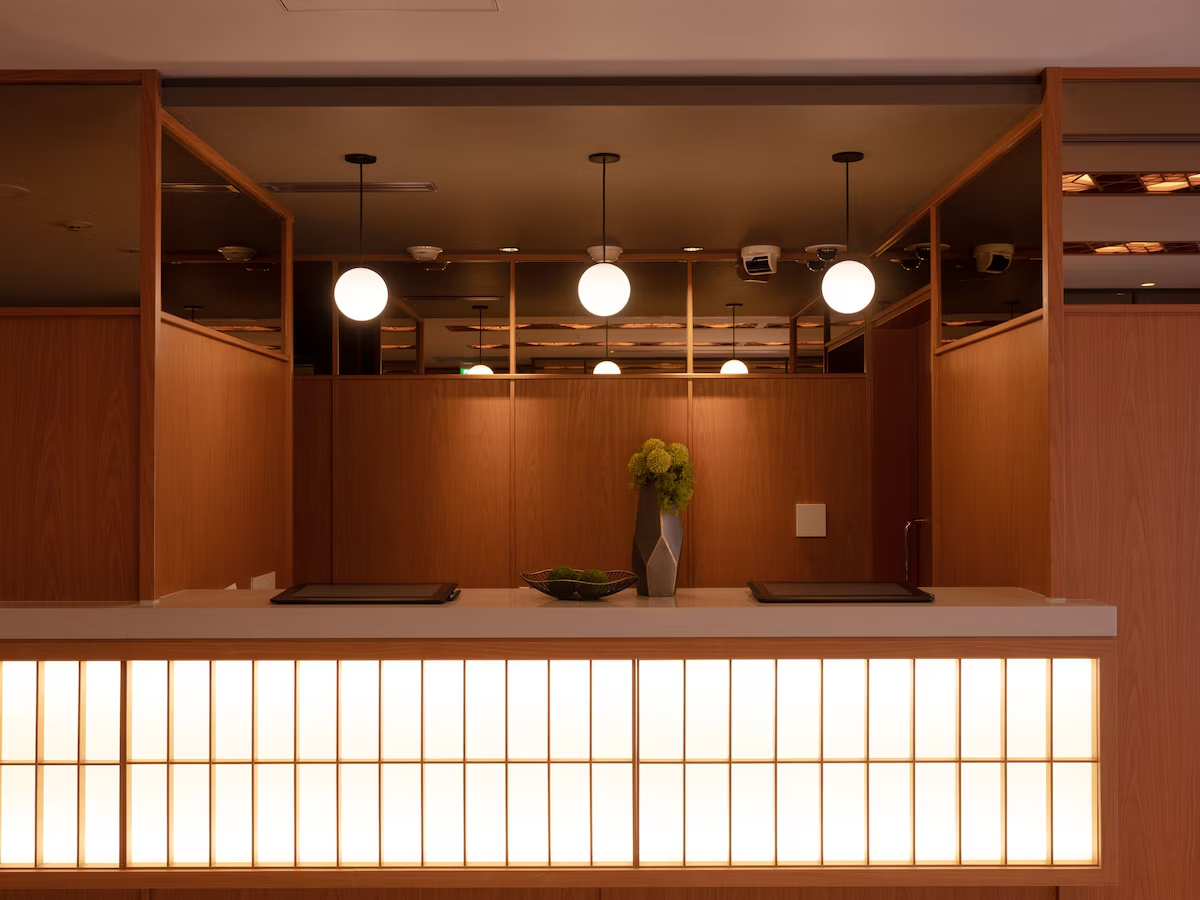
MIMARU Tokyo Asakusa Station is one of the room profiles linked below. This photo shows the property, not a verified room layout or equipment.
Choose the hotel station before choosing the airport train
For a family arriving at Haneda, the useful comparison is Keikyu to the appropriate Tokyo station versus the Tokyo Monorail to Hamamatsucho and an onward journey. Start with the exact hotel address. An Asakusa-line hotel and a hotel approached from JR Ueno can favour different route structures, even when a journey planner gives similar totals.
Choose two complete candidates, including the transfer and the walk to reception. Then decide which your family can manage with its actual bags. A short train ride loses its appeal if the remaining route includes an unplanned station crossing. The examples below are planning exercises based on published access information, not reports of our own airport transfers.
Published facts: Haneda Airport: rail access and terminal gate locations · Toei: Haneda through-service access and departure checks · Tokyo Monorail: Hamamatsucho route and timetable links
Check the terminal before following a familiar set of directions
Use the terminal shown for your flight, rather than assuming every international arrival uses Terminal 3. Haneda provides rail access at all three terminals. The airport places Keikyu and monorail platforms at B1F in Terminals 1 and 2. At Terminal 3, the Keikyu gates for central Tokyo are in the second-floor arrivals lobby; the monorail has gates on the second and third floors.
Keikyu’s Terminal 3 guide then directs passengers downstairs to the platforms and warns that the correct train depends on the destination. Keep the lobby, ticket gate and platform as separate steps. Before moving with children and luggage, confirm the operator on the signs. If you need a lift route, follow the current terminal map instead of copying another passenger’s escalator route.
Published facts: Haneda Airport: rail access and terminal gate locations · Keikyu: Terminal 3 arrivals-to-platform directions
Compare route structures, then check the actual departure
Keikyu and the Toei Asakusa Line operate through services. A suitable train can therefore serve an Asakusa-line destination without a change of train. Confirm the destination and stops on the departure display; the through-service arrangement does not make every Keikyu departure appropriate.
Tokyo Monorail runs to Hamamatsucho, where JR’s timetable lists Yamanote trains towards Tokyo and Ueno. Keikyu to Shinagawa followed by JR is another candidate for those destinations. Compare both complete routes, including transfers and exits. Use current station maps if you need lift access; older saved instructions may show a different layout.
| Hotel-side requirement | Candidate to investigate | Decision that still needs checking |
|---|---|---|
| Toei Asakusa Line station | Suitable Keikyu through service | Does this departure stop at your destination? |
| JR Tokyo or JR Ueno approach | Monorail/Hamamatsucho or Keikyu/Shinagawa, then JR | Transfer route, onward train and final exit |
| Several bags beyond what adults can move together | Quoted road transfer to the hotel | Vehicle capacity, child seats and full terms |
| Arrival close to the end of service | Complete rail connection plus a road fallback | Last usable onward connection, not only the airport train |
Published facts: Toei: Haneda through-service access and departure checks · Tokyo Monorail: Hamamatsucho route and timetable links · JR East: Hamamatsucho lines towards Tokyo and Ueno · Keikyu: late-night and early-morning access · JR East: Shinagawa lines towards Tokyo and Ueno
Three hotels illustrate why the exit matters
Use these published hotel approaches to refine a route, rather than treating an area name as a destination. The walk descriptions identify particular station exits. They are not a promise that a family with a stroller will cover the distance in the advertised time, nor do they establish that those exits are step-free.
For karaksa hotel colors Tokyo Yaesu, the property describes both a Tokyo Station approach and a Nihombashi Station approach. That makes a Keikyu/Toei route worth comparing with its published monorail/JR route. Keep the full property name in your map: the hotel explicitly warns about another nearby karaksa location.
| Hotel | Published approach | What this changes in your plan |
|---|---|---|
| MIMARU Tokyo Asakusa Station | Toei Asakusa Exit A5; Metro Ginza Line Exit 4 is a separate approach | A through arrival uses the Toei directions |
| karaksa hotel colors Tokyo Yaesu | JR Tokyo Yaesu Central Exit, or Nihombashi Exit B1 | Compare the two station-to-door routes |
| MIMARU Tokyo Ueno East | JR Ueno Iriya Exit; Metro Ueno Exit 1 is another approach | Plan the JR exit after a Hamamatsucho transfer |
Published facts: MIMARU Tokyo Asakusa Station: station-specific access · MIMARU Tokyo Ueno East: JR and Metro approaches · karaksa hotel colors Tokyo Yaesu: two station approaches · Toei: Haneda through-service access and departure checks
Hypothetical afternoon arrival: keep one simple rail candidate
Imagine two parents and children aged eight and twelve landing at Terminal 3 at 14:30, with two rolling cases, for MIMARU Tokyo Asakusa Station. They first investigate a Keikyu departure that continues onto the Toei Asakusa Line and stops at Asakusa. Their saved hotel note uses the Toei approach, rather than the nearby Ginza Line’s exit number.
They do not reserve dinner around an assumed landing-to-hotel duration. Arrival formalities, collecting bags and reaching the platform come first. One adult keeps the hotel map ready; the other checks everyone and the bags before boarding. If the displayed departure needs a change, they compare it with the next suitable through train using current information. The decision is about the family’s willingness to transfer, not an automatic rule that waiting is always better.
Published facts: Toei: Haneda through-service access and departure checks · MIMARU Tokyo Asakusa Station: station-specific access
Hypothetical late arrival: test the whole connection
Now imagine two adults, a five-year-old and a ten-year-old landing at 22:30 for karaksa hotel colors Tokyo Yaesu. That is an aircraft arrival time, so they cannot use it as their platform departure time. They compare the published monorail/JR approach with a suitable Keikyu/Toei journey only after allowing for the airport steps.
Keikyu’s late-night page gives airport-to-Shinagawa information. Reaching Shinagawa does not establish an onward train to this hotel. Likewise, a final monorail departure does not establish a usable JR connection. This family checks the entire journey for its travel date and keeps a quoted road option. Before flying, it separately asks the hotel how to check in at its likely arrival time; choosing transport does not settle hotel entry.
Published facts: Keikyu: late-night and early-morning access · Tokyo Monorail: Hamamatsucho route and timetable links · JR East: Hamamatsucho lines towards Tokyo and Ueno · karaksa hotel colors Tokyo Yaesu: two station approaches
Compare the whole party without guessing child fares
Obtain current fares for the actual terminal and destination, including the onward operator where needed. Hotel child categories are not rail ticket categories. For example, Tokyo Monorail’s ticket page distinguishes children aged six to eleven, with school-status exceptions for six- and twelve-year-olds. Its rules also limit the number of accompanying infants travelling free. Ask about the exact party if a boundary age applies.
The monorail has no reserved seats, according to its official FAQ. Buying an ordinary ticket does not allocate four seats together. For a road quote, list every traveller, children’s ages, suitcase sizes and the stroller. Check child-seat arrangements, pickup instructions, waiting after a delayed flight, cancellation and any extra charges. Haneda notes that toll-road charges are added to its flat-rate taxi fares; a fixed headline need not be the complete bill.
Published facts: Tokyo Monorail: age categories and infant rules · Tokyo Monorail FAQ: unreserved seating · Haneda Airport: taxi pickups and flat-rate exclusions
Save an arrival note that still works when plans change
Keep one note with the flight terminal, exact hotel name and address, chosen rail route, arrival station and operator, hotel map, and hotel’s late-arrival instructions. Add a fallback trigger you can use: for example, “If the complete rail connection is no longer possible, compare the saved road option.” Decide this while everyone is rested.
For a reserved vehicle, use its confirmed meeting instructions. Haneda distinguishes ordinary taxi stands from app-dispatched and reserved taxi pickups; they should not be assumed to share a location. Keep the booking reference and contact method available, with enough phone power to use them. Once in Tokyo, check the address before unloading: solving the airport journey includes reaching the correct property with the whole party.
Published facts: Haneda Airport: taxi pickups and flat-rate exclusions
Questions families ask.
Does the Tokyo Monorail go directly to Tokyo Station?
It runs to Hamamatsucho. The hotel route described here continues on JR to Tokyo Station, so include that transfer and the walk to the correct hotel exit.
Can I assume a Keikyu train goes through to Asakusa?
Keikyu and Toei operate through services, but check your departure’s destination and stops. A line connection alone does not establish the stopping pattern of the train in front of you.
Is the last airport train enough for a late arrival?
Check every remaining connection to the hotel, along with late check-in arrangements. A train to Shinagawa or Hamamatsucho can leave you needing a separate final journey.
Sources and scope.
- Haneda Airport: rail access and terminal gate locations
- Keikyu: Terminal 3 arrivals-to-platform directions
- Toei: Haneda through-service access and departure checks
- Tokyo Monorail: Hamamatsucho route and timetable links
- JR East: Hamamatsucho lines towards Tokyo and Ueno
- JR East: Shinagawa lines towards Tokyo and Ueno
- MIMARU Tokyo Asakusa Station: station-specific access
- MIMARU Tokyo Ueno East: JR and Metro approaches
- karaksa hotel colors Tokyo Yaesu: two station approaches
- Keikyu: late-night and early-morning access
- Tokyo Monorail: age categories and infant rules
- Tokyo Monorail FAQ: unreserved seating
- Haneda Airport: taxi pickups and flat-rate exclusions
Hotel and transport conditions can change. This is a planning guide based on published information, not a promise of availability or a report of a personal hotel stay.
Ready to choose a room?
Compare our researched room profiles, then check your dates and guest ages on the booking page.