
The short answer.
- Trace platform, gate, street exit and hotel entrance as one route; a nearby station pin is incomplete.
- A hotel’s shortest walking estimate can refer to a different exit from its listed elevator exits.
- Confirm hotel access and stroller storage for the named room, then recheck elevator notices close to travel.
A property example for this guide.
MONday Apart Ueno Shin Okachimachi is one of the room profiles linked below. This photo shows the property, not a verified room layout or equipment.
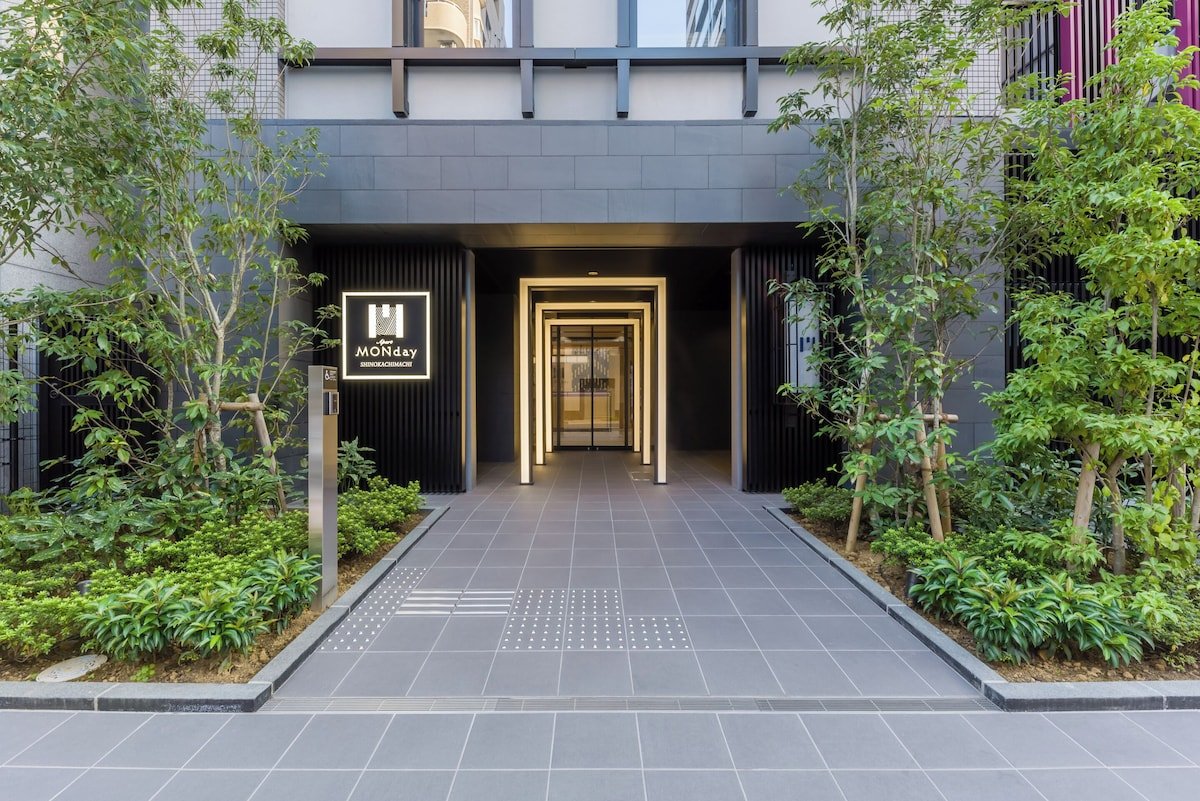
A short station walk is only one part of the route.
A hotel advertised as a few minutes from a station may be close to an entrance you will not use with a stroller. Start with the train line you expect to arrive on, then trace the route from its platform through the ticket gate, to a suitable street exit and on to the hotel entrance. The distance from a different exit can change the final walk.
The same route matters beyond arrival. You may repeat it in the morning, return with a sleeping child, and use it again with suitcases on departure. Consider those trips when comparing two otherwise suitable rooms. A slightly longer walk that you can follow confidently may be more practical than a short route with unresolved stairs.
An accessible station label does not identify every entrance.
Tokyo Metro’s barrier-free search separates elevators inside and outside the ticket gates. Its “One-route” designation can include slopes, stairlifts or wheelchair-accessible escalators as well as elevators. It does not mean every entrance has an elevator-only route.
For your plan, look for the equipment connecting each part you need: the arriving platform to the concourse, the concourse to the relevant gate, and the gate to street level. Check whether a transfer introduces another platform and a new set of equipment. A street elevator on a map is not enough if the platform connection remains unclear.
| Part of the journey | What to record | Unresolved issue to check |
|---|---|---|
| Arrival platform | Operator, line and direction of arrival | Can you reach the concourse using the equipment you need? |
| Ticket gate | Which gate the route passes through | Does the route stay within the paid area or require a different gate? |
| Street exit | Elevator exit and its position on the map | Is the named exit suitable and operating on your travel day? |
| Hotel approach | Walk from that exit to the actual entrance | Are there crossings, steps or a different entrance to use? |
| Return trip | Reverse route to the correct platform | Can you find the same entrance when approaching from the hotel? |
Published facts: Tokyo Metro: search by barrier-free facility
A concrete example: Shin-Okachimachi has different exit listings.
MONday Apart UENO SHIN OKACHIMACHI publishes an approximately three-minute walk from Shin-Okachimachi Exit A1. In a separate elevator-exit entry, it lists A3 and A4 for that station. These are distinct pieces of information: the short walking estimate is not stated as the walking time from either elevator exit.
If this hotel is on your shortlist, use the current station map to connect your arriving platform to the listed elevator exit, then plan the street walk from there. Do not simply attach the A1 walking estimate to an A3 or A4 route. The official hotel page is useful precisely because it distinguishes the entrances.
Apply the same method to other properties. Compare the published nearest exit with the exit you can actually use. Ask about any difference in the final approach rather than rejecting or recommending an entire neighbourhood based on a single station distance.
Published facts: MONday Apart UENO SHIN OKACHIMACHI: access and elevator exits
Check the named station as carefully as the hotel name.
MIMARU Tokyo Asakusa Station’s official directions distinguish the Ginza Line’s Asakusa Exit 4 from the Toei Asakusa Line’s Exit A5, with different walking estimates. Its directions also provide a Universal Design route map. Use that dedicated route information when planning access; a listed nearby exit by itself does not establish a step-free approach.
For a hotel around a large interchange, make a separate note for the route you will use most often and the route from the airport. They may arrive on different platforms or use different entrances. A neighbourhood that works well for your sightseeing line can still need a separate luggage plan on arrival.
When saving the route, include the complete hotel name and address. This is especially useful where a brand has multiple nearby locations. A clear entrance photo from the official access information can help you identify the destination, but do not infer the room layout from an exterior photograph.
Published facts: MIMARU Tokyo Asakusa Station: official directions and Universal Design route map
The hotel entrance and room need a second check.
Ask whether the approach from the street has steps and whether a lift reaches the floor of your booked room. If you need to keep a stroller open on entry, give its width and ask about the relevant doorway or lift. “Family room” is a sleeping-category label, not a measurement of the entrance.
Then check where the stroller will go overnight. A room’s total floor area does not show the clear space left after beds, luggage and furniture. Ask whether a folded stroller can stay in the room, whether another storage arrangement is available, and when you can retrieve it. Do not assume a lobby can store it.
If a room photograph is your only evidence, treat storage as unresolved. The photographed arrangement may differ from the room you receive. A written answer for the exact room type is more useful than estimating clearance from a wide-angle image.
| Question | Detail to give the hotel | What a useful answer establishes |
|---|---|---|
| Entrance access | Your intended station exit and arrival route | Which hotel entrance to use and any steps on the approach |
| Lift and doorway fit | The stroller width; whether it will be folded | Whether the planned access works without guessing dimensions |
| Room storage | The booked room name and folded size | Where it may be kept without assuming spare floor space |
| Separate storage | The times you need to leave and retrieve it | Whether storage exists, its conditions and access hours |
| Arrival luggage | Stroller plus the actual number of bags | Whether you need a different plan for this one journey |
Compare rooms using your daily route, not distance alone.
Imagine two hypothetical hotels with rooms that both fit your family. One advertises a two-minute station walk, but you have not identified the elevator route or hotel entrance. The other is farther away, and you have confirmed the complete approach and stroller storage. The first hotel still needs answers before its shorter distance can count as a practical advantage.
Write down your main sightseeing journeys and where each starts. If your plan uses one line repeatedly, its platform-to-hotel route deserves more weight than a station you will use only once. Conversely, a stay built around several day trips may make the route with departure luggage more important.
Recheck elevator operation close to travel.
Tokyo Metro publishes elevator shutdown information for maintenance and renewal work, including a page for the current day. A route that appears on a station map may need a different approach during an outage. Check the current notice before relying on the route, especially for an airport arrival or departure.
Save the usual route and one alternative you are prepared to use. This might be another suitable station entrance or a separately arranged transfer to the hotel. Check the alternative rather than assuming it solves the same access problem. A vehicle quote still needs to cover your party and luggage, including the stroller.
Keep route screenshots available offline, along with the hotel address and contact method. If equipment is unavailable on arrival, ask station staff for the current route. Do not treat a planning article or an older screenshot as confirmation that a lift is operating at that moment.
Published facts: Tokyo Metro: elevator shutdown notices and barrier-free information
Send a request that the hotel can answer precisely.
A useful message is: “We will arrive on the Toei Oedo Line with a stroller and two suitcases. Which elevator exit should we use, and is the route from there to your entrance step-free? Our folded stroller is [dimensions]. Can we keep it in [exact room name], or is there another storage option?” Add your travel dates and replace the example details.
If access is essential, resolve the route and room questions before buying a rate with cancellation terms you cannot accept. Save the replies with your reservation and recheck after changing the room or arrival line.
Questions families ask.
Does an accessible station mean every entrance has an elevator?
No. Check the specific route through the station. Tokyo Metro lists different barrier-free facilities, and its One-route designation is broader than an elevator-only route.
Can I use the hotel’s advertised station walking time?
Use it for the entrance it actually names. If your stroller route uses another exit, plan that street walk separately. Walking estimates are reference points, not guaranteed journey times.
Will an apartment hotel automatically have room for a stroller?
Do not assume so. Give the hotel the folded dimensions and exact room name, and ask where it can be stored. Total room area and a photograph do not establish the remaining clear space.
Sources and scope.
- Tokyo Metro: search by barrier-free facility
- Tokyo Metro: elevator shutdown notices and barrier-free information
- MONday Apart UENO SHIN OKACHIMACHI: access and elevator exits
- MIMARU Tokyo Asakusa Station: official directions and Universal Design route map
Hotel and transport conditions can change. This is a planning guide based on published information, not a promise of availability or a report of a personal hotel stay.
Ready to choose a room?
Compare our researched room profiles, then check your dates and guest ages on the booking page.