
The short answer.
- Count the reserved seats you want separately from the people travelling: a toddler's own reserved seat needs a child ticket.
- The unreserved deck-storage trial does not remove the oversized-suitcase reservation requirement.
- Compare the hotel-to-Shinkansen route with your whole Tokyo stay before moving hotels for one departure.
A property example for this guide.
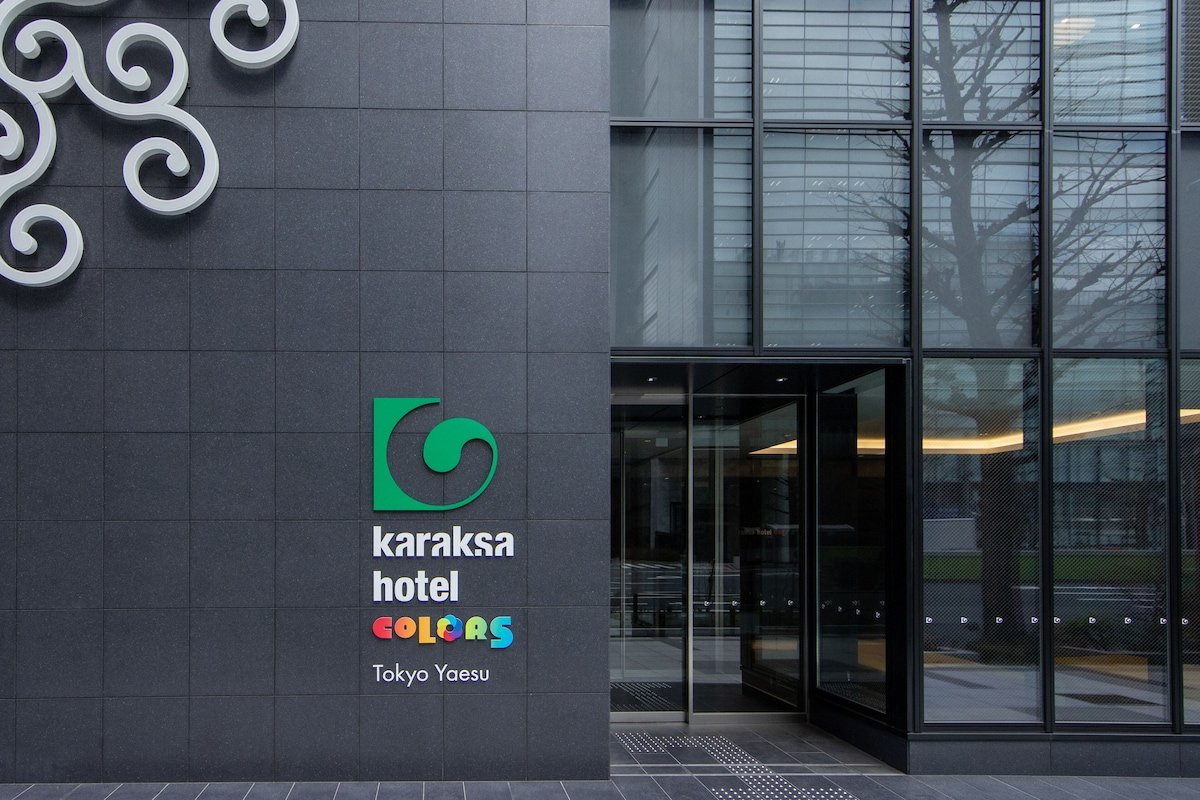
karaksa hotel colors Tokyo Yaesu is one of the room profiles linked below. This photo shows the property, not a verified room layout or equipment.
Choose the departure station before changing your Tokyo hotel
A family transfer to Kyoto begins at the hotel door, before the Shinkansen journey. Write down the luggage you will carry, the seats you need and the station on the reservation. Tokyo and Shinagawa are boarding stations on the Tokaido route to Kyoto. Staying in Ueno or Shinjuku means planning a separate journey to your chosen boarding station; finding a Shinkansen sign locally does not identify the Kyoto service.
Compare two complete plans: keep the Tokyo room that suits your daily outings, or move closer to the departure station. A move adds packing, checkout, luggage handover and another check-in. It can make sense for an important early departure, but it also consumes part of the preceding day. Put those tasks beside the expected benefit rather than treating every Tokyo-to-Kyoto trip as a reason to change hotels.
This guide covers a Tokyo-to-Kyoto family transfer on the Tokaido Shinkansen. It uses official information checked on 7 October 2026 and labelled planning examples. Other Shinkansen routes, rail passes and discounted products need their own rules. No prices or available seats for your dates are implied.
Published facts: JR Central: current timetable and peak-period seat notice · SmartEX: Tokaido, Sanyo and Kyushu route overview
Decide who needs their own seat
JR Central normally classifies ages 6–11 as children and ages 12 and above as adults. Its school-related exceptions for ages six and twelve apply to elementary schools established under Japanese law. An overseas school year does not establish the exception. Confirm boundary cases before buying.
Babies and children under six normally travel free when accompanied, subject to the operator's exceptions. A baby or young child occupying their own reserved seat needs a child ticket. A third and subsequent infant accompanying one adult or fare-paying child also requires a fare. The adult/child classification for the railway is separate from the hotel's bed-sharing policy.
For a toddler, choose between sharing an adult's place and purchasing a separate reserved seat before comparing the family total. Consider how the adult will eat, handle a sleeping child and reach the supplies bag. Free travel can be useful, but it does not supply an empty neighbouring seat. If your plan depends on four places, search and pay for the four applicable tickets.
| Travellers | Intended sitting plan | Tickets to price |
|---|---|---|
| Two adults, children aged 7 and 10 | One reserved seat each | 2 adult + 2 child tickets |
| Two adults, children aged 3 and 8 | Three-year-old shares an adult's place | 2 adult + 1 child tickets; 3 reserved seats |
| Same family: children aged 3 and 8 | Each child has a separate reserved seat | 2 adult + 2 child tickets; 4 reserved seats |
| Two adults and a 12-year-old visitor educated overseas | One reserved seat each | Normally 3 adult tickets; home-country school status is not the Japanese-law exception |
Published facts: JR Central: adult, child, infant and baby ticket rules · SmartEX: reserving child tickets and infant seats
Measure the suitcases and distinguish the two storage spaces
Add each suitcase's length, width and height. JR Central's current summary distinguishes bags totalling 160 cm or less from oversized bags over 160 cm and up to 250 cm. The latter require a seat with an oversized baggage area. Bags over 250 cm cannot be brought aboard.
Some deck compartments currently operate as shared storage without reservation on a trial basis. This does not remove the oversized-bag requirement. The deck-storage alternative is useful for qualifying smaller bags, but it is shared space, not a guaranteed bay.
A stroller is exempt from the oversized-baggage reservation rule. Using the designated oversized baggage area for it still requires the corresponding seat reservation. Measure its folded shape and decide where you will put it before choosing seats.
| Length + width + height | Result | Planning consequence |
|---|---|---|
| 75 + 50 + 30 cm | 155 cm | Within the smaller-bag category; still plan a manageable storage location |
| 80 + 55 + 30 cm | 165 cm | Reserve the appropriate oversized-baggage seat or arrange an alternative to carrying it |
Published facts: JR Central Japanese rules: exact 160 cm boundary and deck-storage scope · JR Central and JR West: deck-storage trial notice and oversized-bag exclusion
Check the family seat arrangement, not just the train's availability
In SmartEX, use the seat map to check the actual oversized-baggage seats. A train-wide availability symbol does not prove those seats are free. Mixing an oversized-baggage seat and an ordinary reserved seat requires separate reservations. The special baggage-seat operation supports up to five people in Ordinary Car or four in Green Car, within one car; larger or cross-car groups require multiple operations. SmartEX also excludes these seats from after-hours and presale requests; its baggage guide directs bookings to the normal sales window from one month before departure.
That differs from ordinary smartEX Service's general limit of six people; its after-hours limit is three between 23:30 and 05:30 Japan time. For a six-person family, decide which passengers need access to baggage space and how every child will sit with a supervising adult. Do not assume a six-person search will produce one block of six baggage seats. If separate reservations are needed, confirm the same date, train, class, car and seat positions across them.
For an illustrative family needing four seats and carrying one oversized suitcase, first check a usable four-seat arrangement with the required baggage access. If it is unavailable, compare another train or a smaller luggage plan. Do not complete a partially suitable arrangement on the assumption that neighbouring seats will appear later. The reservation record should show the arrangement you are relying on.
A family-labelled car is a limited-time option in the booking guide, not a facility on every departure. Choose a workable reserved arrangement even if that option is absent. Where sitting together is essential, avoid accepting separated seats simply to finish the booking.
Published facts: SmartEX: baggage-seat reservations, mixed bookings and group limits · SmartEX: service scope, passenger limit and conventional-line fares · SmartEX: seat maps, reservations and boarding methods
Compare carrying every bag with sending some ahead
Before adding a hotel move, test whether fewer suitcases solve the difficult part. Keep one accessible transfer bag and assess forwarding the other luggage. The receiving hotel's agreement, courier delivery date and sending cutoff must all work. Our luggage-forwarding guide separates those checks from hotel storage and airport-departure services.
Hypothetical plan: a family spends four nights in Tokyo, then travels to Kyoto. They ask both hotels and the courier about dispatch before departure, keeping clothes and supplies for the confirmed delivery window. If the answer does not fit the stay, they carry the bag with an appropriate rail arrangement. This is a planning example, not a claim of next-day or same-day delivery between the two cities.
Put three alternatives side by side: carry the luggage, forward part of it, or change the Tokyo hotel. Compare the actual complete costs, handling tasks and time without the forwarded bags. The most useful choice removes a specific difficulty without creating an unresolved delivery or room-access problem.
Shortlist a Tokyo Station room by its beds as well as its address
If Tokyo Station is your chosen departure point, the two karaksa properties below offer concrete room comparisons. The hotel's published walk to the station is an access estimate; it does not include finding the Shinkansen gate, using elevators or reaching your car. Save the exact property name and address, because these are different hotels.
The colors Tokyo Yaesu Comfort Quadruple has four 90 cm-wide singles and an in-room washer-dryer. TOKYO STATION's Family Quadruple has two singles, an extra bed and a sofa bed. The address does not erase that sleeping difference. For the preceding nights, choose beds that fit the people who will use them; a useful departure location cannot compensate for an unsuitable sleeping plan.
Use the room profiles below to compare those layouts, then enter all travellers and their ages on the actual booking channel. The official room descriptions establish the layout, not Expedia availability for your dates. Match cancellation, payment and the full stay total. Keep any property-specific direct-booking child benefit separate from an online travel agency offer.
| Exact property and room | Published sleeping layout | Published station approach | Question before choosing |
|---|---|---|---|
| karaksa hotel colors Tokyo Yaesu — Comfort Quadruple | 4 single beds; capacity up to 4 | Hotel access page estimates 6 minutes from JR Tokyo Station | Do four equal beds and in-room laundry matter for the Tokyo nights? |
| karaksa hotel TOKYO STATION — Family Quadruple | 2 singles + extra bed + sofa bed; capacity up to 4 | Hotel access page estimates a 5-minute walk from Tokyo Station | Are the extra bed and sofa bed suitable for their intended guests? |
Published facts: karaksa colors Tokyo Yaesu: exact Comfort Quadruple room · karaksa TOKYO STATION: exact Family Quadruple room · karaksa colors Tokyo Yaesu: official access · karaksa TOKYO STATION: official access
Save a departure-day record that either adult can follow
SmartEX offers boarding by QR ticket, an assigned IC card or collected paper tickets. Confirm the method shown for your reservation and follow its instructions for every fare-paying passenger. Ordinary smartEX Service combines the Shinkansen base fare and limited-express component, but conventional trains to or from the boarding station are paid separately. A stored-value Suica balance alone does not create your Shinkansen reservation.
Build your departure time backwards from boarding, including checkout, the street approach, station navigation, any ticket collection and a family comfort stop. There is no single reliable station buffer for every family. Check the route with the stroller and carried bags, and add time for tasks you have actually chosen.
Keep the Kyoto hotel address and arrival instructions in the same note. A completed rail reservation ends at the station, while the family still needs to reach the room and know when it can enter. Make that final leg part of the transfer before planning a timed activity after arrival.
- Exact departure date in Japan, boarding station, train name and number, and departure time.
- Adult/child tickets, each reserved seat, and which adult accompanies each child.
- Confirmed baggage-seat access where required, plus the plan for every other bag and the stroller.
- Boarding credentials and any collection instructions, accessible without opening a suitcase.
- Hotel checkout procedure, station approach and a fallback if the planned route is disrupted.
- Small supplies bag with travel documents, essential medicines, chargers, drinks and the children's immediate needs.
- Kyoto hotel address, arrival instructions and the agreed receipt details for any forwarded luggage.
Published facts: SmartEX: seat maps, reservations and boarding methods · SmartEX: service scope, passenger limit and conventional-line fares
Questions families ask.
Does a three-year-old need a Shinkansen ticket?
For accompanied travel, a young child can normally travel free subject to the operator's infant rules. A separate reserved seat requires a child ticket. Decide whether the child will share an adult's place before pricing the family journey.
Does free deck storage mean I no longer need an oversized-baggage seat?
No. The current shared deck-storage trial does not remove the reservation requirement for suitcases over 160 cm and up to 250 cm in total dimensions. Check the current official luggage guide before travel.
Can six people reserve oversized-baggage seats together in one SmartEX operation?
The special baggage-seat operation has lower limits than the ordinary service: five people in Ordinary Car or four in Green Car, within one car. Larger groups need multiple operations and should check the resulting train, car and seats together.
Should we move from Ueno to Tokyo Station for the last night?
Compare the complete transfer with the work of another hotel move. An early departure or difficult luggage route can justify a change, but forwarding some bags or keeping a practical existing room may serve the family better. Confirm the route and dated room offers before deciding.
Sources and scope.
- JR Central: current timetable and peak-period seat notice
- SmartEX: Tokaido, Sanyo and Kyushu route overview
- JR Central: adult, child, infant and baby ticket rules
- SmartEX: reserving child tickets and infant seats
- SmartEX: baggage-seat reservations, mixed bookings and group limits
- SmartEX: service scope, passenger limit and conventional-line fares
- SmartEX: seat maps, reservations and boarding methods
- karaksa colors Tokyo Yaesu: exact Comfort Quadruple room
- karaksa TOKYO STATION: exact Family Quadruple room
- karaksa colors Tokyo Yaesu: official access
- karaksa TOKYO STATION: official access
- JR Central Japanese rules: exact 160 cm boundary and deck-storage scope
- JR Central and JR West: deck-storage trial notice and oversized-bag exclusion
Hotel and transport conditions can change. This is a planning guide based on published information, not a promise of availability or a report of a personal hotel stay.
Ready to choose a room?
Compare our researched room profiles, then check your dates and guest ages on the booking page.