
The short answer.
- Use a separate card or ticket for each fare-paying rail traveller; one phone is not a family rail wallet.
- Welcome Suica Mobile requires age thirteen or above and does not support child fares.
- Check the physical-card collection location, identification, validity and first airport journey before arrival.
A property example for this guide.
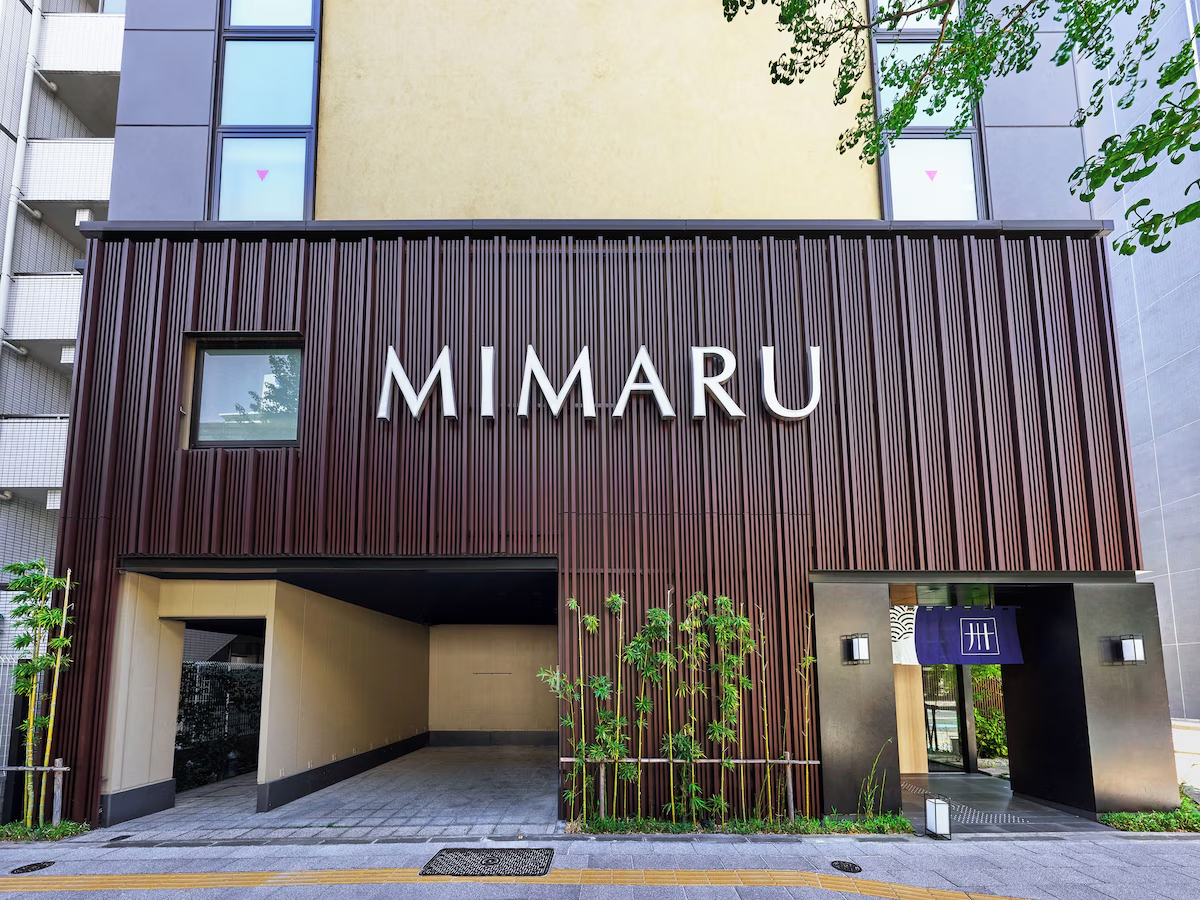
MIMARU Tokyo Ueno East is one of the room profiles linked below. This photo shows the property, not a verified room layout or equipment.
Give each fare-paying rail passenger their own card or ticket.
For a family using Tokyo trains, choose the fare category first, then the card or phone. A parent can manage the children’s cards, but one Suica is not a group rail ticket. JR East’s IC rules make a fare card valid for one person on a journey. Its mobile rules also prohibit multiple people using the cards on one mobile device simultaneously.
Consider two adults and children aged seven and ten, making ordinary local-train trips from a Tokyo hotel. A workable arrangement is a separate adult mobile card on each eligible parent’s phone and one physical child card for each child. That is four travel credentials, even though there are only two phones. Physical adult cards can replace the parents’ mobile cards if setup is unsuitable.
Keep the same credential for entry and exit. Before a gate, decide who will help each child, with an adult ready on the far side. If a card fails, ask staff rather than handing another family member’s card back through the gate.
Published facts: JR East: IC card ticket rules, Article 40 one-person rail validity · JR East: mobile Suica rules, simultaneous use and entry/exit
Match age rules to the operator, rather than the hotel.
JR East’s current fare guide classifies ages six to eleven as children and ages twelve and above as adults. It lists exceptions for a six-year-old who has not entered elementary school and a twelve-year-old still attending it, but explicitly defines that school as one established under Japanese law. Do not apply your home country’s school year to those exceptions.
Children under six generally travel without a fare when accompanied, subject to JR East’s rules. More than two infants aged one to five accompanying one adult or child, travel alone, or a baby or infant occupying their own reserved seat can require child fares. Confirm the ticket for the specific service; a hotel’s free bed-sharing policy says nothing about rail eligibility.
Ask staff about boundary cases before buying a child card. JR East’s child Welcome Suica has an age-related expiry at the first March 31 after the twelfth birthday; that card-validity rule is not a blanket child-fare entitlement for every twelve-year-old overseas visitor. The physical card’s own trip validity still applies.
| Traveller | Planning choice | Point that changes the answer |
|---|---|---|
| Adult with compatible iPhone | Their own adult mobile or physical card | Successful setup and payment eligibility |
| Seven- and ten-year-old children | One physical child card per child | Bring each child’s identification |
| Twelve-year-old overseas visitor | Plan an adult physical card; check any applicable exception | Welcome Suica Mobile requires age thirteen or above |
| Accompanied four-year-old, ordinary local train | Check the infant exemption before buying a fare | Accompanying-party limits and a reserved seat change the calculation |
| Teen aged thirteen or above | Adult physical card or eligible mobile setup | A phone alone does not establish Apple Pay payment eligibility |
Published facts: JR East: adult and child fare categories, including Japanese-school exceptions · JR East: visitor IC-card rules, reference paper and child identification
Welcome Suica Mobile has its own eligibility rules.
The English visitor app, Welcome Suica Mobile, is for users aged thirteen or above and is unavailable to elementary-school students. It does not support child fares. Those conditions differ from other services called Mobile Suica: do not use advice about a different app to set up a child’s fare.
JR East’s device FAQ lists iPhone XR/XS and later with iOS 17.2 or higher, and Apple Watch Series 3 and later. Keep the software current and check the official requirements for the exact device. Welcome Suica Mobile is an iOS/watchOS service; an Android phone does not run this visitor app.
The app’s terms require an eligible Apple Pay payment card in the user’s own name, and consent from a legal representative for a minor. A parent’s payment card is not automatically an eligible funding method for a teenager’s account. A physical adult card is a practical alternative when the payment setup is unresolved.
Published facts: JR East: Welcome Suica Mobile basic-information FAQs, age and SIM requirements · JR East: Welcome Suica Mobile compatible devices · JR East: Welcome Suica Mobile terms, own-name payment and minor consent
Plan physical-card pickup around the hotel journey.
JR East currently lists Welcome Suica machines at Narita Airport Terminal 1 Station, Airport Terminal 2・3 Station, and Haneda Airport Terminal 3’s Tokyo Monorail station. Its listed Travel Service Centers include Tokyo, Ueno and Shinjuku. Check the selected location’s operating hours before counting on it after a late flight; this list does not guarantee a machine is working or a counter is open.
For a child Welcome Suica, have the child’s passport or other identification ready. A family member may buy it on the child’s behalf with that identification; a Welcome Suica machine asks for the intended child’s birth date. Keep the issued reference paper.
An arrival at Haneda Terminal 2 is not an arrival at the Terminal 3 Monorail sales location. Similarly, buying cards at JR Ueno does not make JR Ueno your airport train’s arrival station. Choose the airport-to-hotel route first. If card collection would add an awkward detour, arrange the first journey’s appropriate tickets and collect cards later at a confirmed location.
Published facts: JR East: physical Welcome Suica purchase, sales locations, top-ups and validity
Treat the two Welcome Suica validity periods separately.
The ordinary physical Welcome Suica lasts twenty-eight days including purchase day. Welcome Suica Mobile lasts 180 days from issue. Both normally leave unused stored value non-refundable; do not load an entire holiday budget just because the card can hold it. Special malfunction procedures are separate.
If your stay exceeds twenty-eight days or you expect another visit, compare regular Suica before choosing the short-stay card. JR East describes a ¥500 deposit for a regular physical Suica and a return process deducting a ¥220 handling fee from its remaining balance. Its ten-year non-use rule differs from Welcome Suica’s fixed validity. Confirm the issuing company and return location.
For a family, each balance needs attention. An illustrative starting allocation of ¥1,500 to each adult and ¥1,000 to each of two children totals ¥5,000: (2 × ¥1,500) + (2 × ¥1,000). This is a chosen budgeting example, not a fare estimate or a promise that those amounts cover your journeys. Adjust to the actual trips and add funds when needed.
Published facts: JR East: visitor IC-card rules, reference paper and child identification · JR East: Welcome Suica Mobile overview and validity · JR East: regular Suica deposit, refund and non-use rules
Separate cash top-ups, mobile data and train supplements.
Top up the physical Welcome Suica with Japanese-yen cash at supported machines or Seven Bank ATMs; credit cards cannot be used for its top-ups. For the app, issuing and adding value require location services, and some countries restrict these actions until arrival in Japan. Complete a successful setup before relying on it for the first train.
Welcome Suica Mobile does not require buying a SIM: Wi-Fi can support setup. JR East distinguishes using an existing balance from app operations such as top-ups, which need a stable connection. Keep the device powered and charged. An eSIM can help with maps and online operations, but it does not create child-fare support or solve payment-card eligibility.
A stored-value card is not an unlimited travel pass or a reserved seat. JR East explains that limited-express trains require the appropriate express ticket in addition to the basic fare, and Narita Express has reserved seats only. For Skyliner or any other airport product, check its own operator’s complete ticket requirements. Keep those reservations separate from the family’s local-train cards.
Published facts: JR East: physical Welcome Suica purchase, sales locations, top-ups and validity · JR East: Welcome Suica Mobile setup and location settings · JR East: Welcome Suica Mobile basic-information FAQs, age and SIM requirements · JR East: Welcome Suica Mobile communication requirements · JR East: basic fares, limited-express supplements and reserved seats
Save a card plan beside the hotel address.
Before departure, make one row per person: age on travel day, rail fare category, physical card or exact mobile service, who carries it, and the first journey’s ticket. Add the collection location and a fallback if arrival falls outside its hours. Keep children’s identification and the required reference paper accessible without packing them into a forwarded suitcase.
Use your hotel base to check the daily route, not to choose a different card for each neighbourhood. A Ueno or Asakusa stay still needs the correct station, line and stroller route. If the family splits for an afternoon, each group needs its own travel credentials, hotel address and meeting plan. Decide who holds each child’s card before separating.
On the final day, preserve enough usable balance for the journeys you intend to make. Check each person separately and avoid an unnecessary large top-up. Resolve a gate or card issue with station staff while you are still there; a balance screenshot cannot replace a valid travel credential.
Published facts: JR East: visitor IC-card rules, reference paper and child identification
Questions families ask.
Can my child use Welcome Suica Mobile for the cheaper child fare?
No. JR East says Welcome Suica Mobile has no child fares and requires users to be thirteen or older, excluding elementary-school students. Plan an eligible physical child card or the appropriate child tickets.
Can two children travel through train gates using one parent’s Suica?
No. A rail fare card is for one person per journey. A parent may carry and help manage separate physical cards, but each fare-paying child needs their own valid card or ticket.
Is a twelve-year-old overseas primary-school student automatically eligible for child fares?
Do not assume so. JR East’s school exceptions specifically refer to elementary schools established under Japanese law. Confirm the category with staff using the child’s age and school circumstances.
Does a family need an eSIM to use Suica?
A physical card does not require a phone. Welcome Suica Mobile can use Wi-Fi for online setup and top-ups, while an existing balance can be used without a network connection on a powered device. A separate mobile-data plan is a travel convenience, not a child-fare feature.
Sources and scope.
- JR East: physical Welcome Suica purchase, sales locations, top-ups and validity
- JR East: Welcome Suica Mobile overview and validity
- JR East: Welcome Suica Mobile basic-information FAQs, age and SIM requirements
- JR East: Welcome Suica Mobile compatible devices
- JR East: Welcome Suica Mobile setup and location settings
- JR East: adult and child fare categories, including Japanese-school exceptions
- JR East: IC card ticket rules, Article 40 one-person rail validity
- JR East: visitor IC-card rules, reference paper and child identification
- JR East: Welcome Suica Mobile terms, own-name payment and minor consent
- JR East: mobile Suica rules, simultaneous use and entry/exit
- JR East: Welcome Suica Mobile communication requirements
- JR East: regular Suica deposit, refund and non-use rules
- JR East: basic fares, limited-express supplements and reserved seats
Hotel and transport conditions can change. This is a planning guide based on published information, not a promise of availability or a report of a personal hotel stay.
Ready to choose a room?
Compare our researched room profiles, then check your dates and guest ages on the booking page.