
The short answer.
- Tokyo’s April 2027 percentage tax is a future rule; use each night’s stay date.
- Calculate from the eligible per-person accommodation amount, not an all-in family total.
- Separate full accommodation cost, payment timing and temporary deposits.
A property example for this guide.
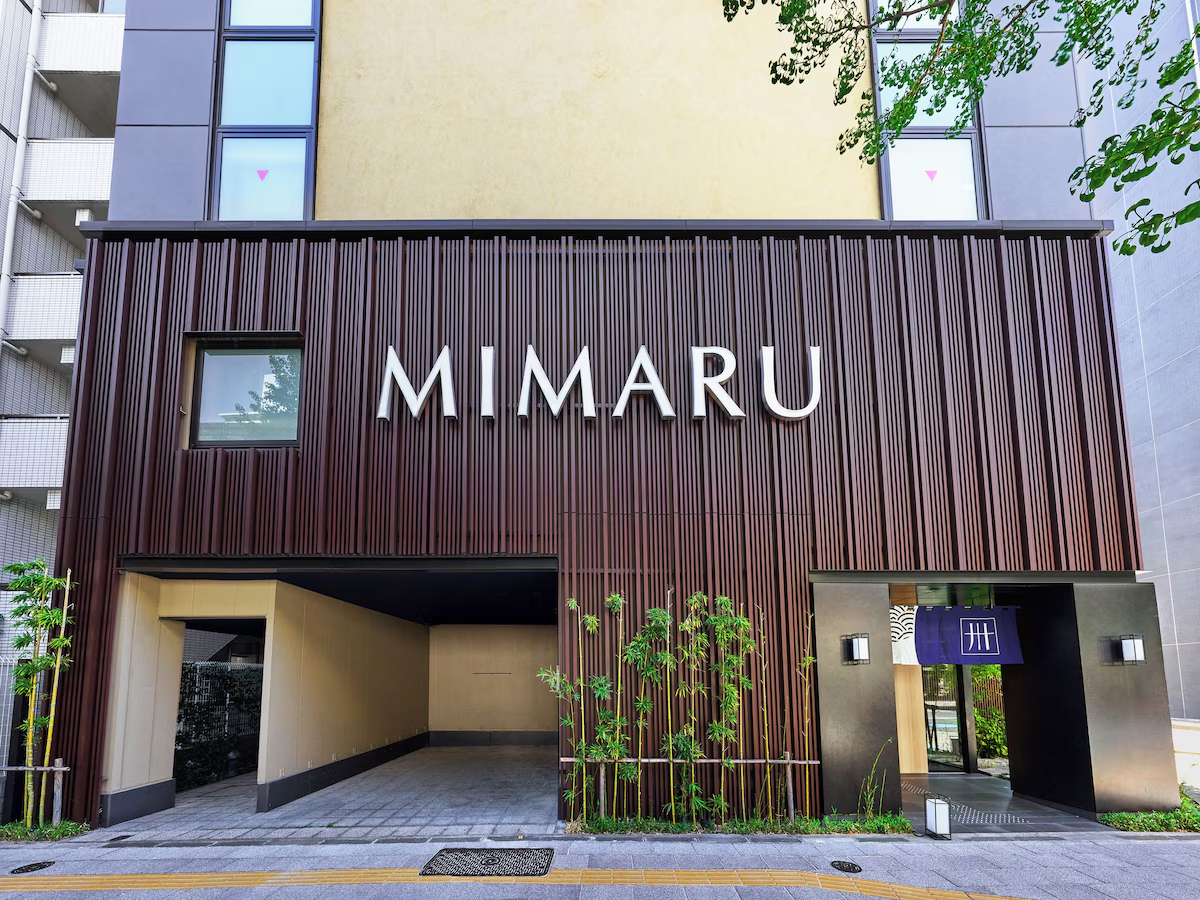
MIMARU Tokyo Ueno East is one of the room profiles linked below. This photo shows the property, not a verified room layout or equipment.
Compare what the family will pay, then when it is due
A booking total and an amount charged today can be different numbers. Start with the room and prepared beds your family actually needs, then record every mandatory charge for the whole stay. Keep optional spending, such as an added breakfast or extra cleaning you choose, in a separate line so it does not disappear from your budget.
This guide covers two questions: how Tokyo accommodation tax affects the family bill, and how to separate an online payment from money still due at the hotel. For cancellation deadlines and the cost of flexibility, use our related refundable-rate guide. A lower amount due today is not, by itself, a lower total price.
Use the tax rules for the night you stay
As checked on 7 October 2026, Tokyo’s current hotel and ryokan tax bands remain in force through 31 March 2027. A future change takes effect on 1 April 2027: an eligible accommodation charge below ¥13,000 per person per night is exempt; at or above that amount the rate becomes 3%. The percentage applies to the eligible charge, rather than just the amount above the threshold.
Both systems use a per-person, per-night amount. A ¥60,000 family-room price is not automatically a ¥60,000 charge per person. Obtain the hotel’s eligible amount before applying the table. These are Tokyo Metropolitan rules; use the relevant local authority if your next stay is outside Tokyo.
| Eligible charge per person, per night | Nights through 31 March 2027 | Nights from 1 April 2027 |
|---|---|---|
| Below ¥10,000 | ¥0 | ¥0 |
| ¥10,000 to below ¥13,000 | ¥100 | ¥0 |
| ¥13,000 to below ¥15,000 | ¥100 | 3% after rounding the eligible charge down to the nearest ¥100 |
| ¥15,000 or more | ¥200 | 3% after rounding the eligible charge down to the nearest ¥100 |
Published facts: Tokyo Bureau of Taxation: current overview and 1 April 2027 change · Tokyo Bureau of Taxation: revision timeline and enacted future system
Find the taxable amount before dividing the room bill
Tokyo’s guest FAQ excludes meals and consumption-tax amounts from the accommodation-tax base, while including service charges relating to lodging. Children can also be liable when their eligible per-person charge reaches the applicable threshold; being a child is not a blanket exemption.
The authority’s operator guidance also includes lodging-related charges such as bedding and mandatory cleaning in its defined accommodation amount. Ask the property for an itemised calculation if the rate bundles meals, cleaning or extra bedding. Do not multiply an entire breakfast-inclusive, tax-inclusive checkout total by 3%.
For a young child sharing a bed, give the hotel the actual age, room, booked party and sharing arrangement. Ask how it will calculate each guest’s eligible accommodation amount. The bed-sharing policy in a room profile answers a sleeping and booking question; it does not establish the tax breakdown for a live rate. Keep every guest accurately recorded.
Published facts: Tokyo Bureau of Taxation: guest FAQ, taxable basis and children · Tokyo Bureau of Taxation: operator FAQ, calculation and stay-date rules
A worked family example across the April 2027 change
Hypothetical example only: two parents and children aged nine and thirteen occupy one room. Assume the hotel confirms an eligible charge of ¥15,000 for each of the four guests on every night, equivalent to ¥60,000 for the room before excluded items. These invented amounts are calculation inputs, not hotel prices or available offers.
For seven nights entirely before the change, accommodation tax is ¥200 × 4 × 7 = ¥5,600. For seven nights entirely from 1 April 2027, it is ¥450 × 4 × 7 = ¥12,600. The difference is ¥7,000 for the same assumed eligible room charge. A family-rate comparison that omits this line would miss that difference.
| Stay dates | Family tax calculation | Accommodation tax total |
|---|---|---|
| Seven nights through 31 March 2027 | ¥200 × 4 guests × 7 nights | ¥5,600 |
| Seven nights from 1 April 2027 | ¥450 × 4 guests × 7 nights | ¥12,600 |
| Nights of 30 March, 31 March and 1 April 2027 | ¥800 + ¥800 + ¥1,800 | ¥3,400 |
Published facts: Tokyo Bureau of Taxation: current overview and 1 April 2027 change · Tokyo Bureau of Taxation: revision timeline and enacted future system
A reservation made in 2026 does not preserve the old tax
Tokyo’s operator FAQ specifies that the stay date controls the revised rate, irrespective of when the reservation was made. For a booking spanning 1 April 2027, check the nights separately rather than applying one rule to the entire reservation.
Under the revised calculation, the authority rounds the eligible per-person nightly charge down to the nearest ¥100 before multiplying by 3%. Ask for the property’s exact calculation if your rate is not a round amount, changes each night or includes a package. Keep its tax estimate with the reservation and recheck the official notice before travel.
Published facts: Tokyo Bureau of Taxation: operator FAQ, calculation and stay-date rules
Pay Now and Pay Later describe collection, not the whole bill
Expedia’s US terms say Pay Now typically charges the booking amount when booked, while Pay Later typically lets the provider charge in local currency during the stay or at another time disclosed in the booking process. The selected offer establishes the actual schedule. The terms also allow separate local-tax collection and a check-in deposit for incidental expenses.
Make three entries: money charged now, mandatory money still due later, and any temporary deposit. Do not add a refundable deposit to the accommodation price as if it were a permanent fee. Do allow for the stated deposit when deciding how much available card balance or cash you need. Confirm its amount, accepted method and release process with the property.
Save the currency of each payable amount. A converted display is not enough to explain what a later hotel payment will debit from your account. Check your own card issuer’s conversion and cross-border fees rather than assuming they are included in the hotel quotation.
Published facts: Expedia US terms: Pay Now, Pay Later, local taxes and deposits
Check collection instructions for the property and channel
MIMARU’s accommodation terms say local lodging tax is collected separately on site. &Here TOKYO UENO’s checked English FAQ says accommodation tax is outside the reservation price and collected at check-in. Those notices are useful planning evidence; they do not establish every Expedia room plan’s final cost breakdown.
Read the actual reservation’s payment and tax lines alongside the property notice. If both appear to include the same tax, ask which amount has already been collected before adding it again. A prepaid room can still leave an on-site payment; a property-payable label does not tell you whether cash, a card or another method is accepted for that charge.
Published facts: MIMARU accommodation terms: local tax collected on site · &Here TOKYO UENO FAQ: separate accommodation tax and check-in collection
Use a family cost sheet for direct and OTA offers
Match dates, exact room category, child ages, prepared beds and inclusions first. Then compare the full payable accommodation cost, not an average nightly headline or the first payment. Keep the cancellation record linked to the same offer so that a cheaper total does not quietly substitute a different level of flexibility.
For two rooms, maintain one sheet per room and add the totals after each breakdown is complete. If meals or bedding are different, show the difference instead of calling the offers equivalent. Use the related room profiles to inspect the layout, then open the provider to check your party and dates. A hotel link alone does not establish an available four-person room or a particular payment option.
| Cost field | What the family needs to record |
|---|---|
| Room and all guests | Exact room, every age and prepared bedding; same dates on both channels |
| Full room-plan total | Whole-stay amount and currency; included meals, bedding and cleaning |
| Accommodation tax | Included, already collected or payable separately; hotel calculation for each night |
| Other mandatory amounts | Amount, reason, currency, collecting party and due date |
| Optional spending | Breakfast for uncovered guests, requested services or other choices your family will use |
| Payment and deposit | Due now, due later, accepted method and any separate temporary deposit |
| Final comparison | All mandatory amounts counted once; optional spending shown separately |
Ask one precise question before paying
Send: “For [dates], [exact room] and two parents with children aged [ages], please confirm the full payable amount for [rate and booking channel]. Is Tokyo accommodation tax included or paid separately, what eligible amount is used for each night, and when and how do we pay? Please also confirm any mandatory supplements and the amount and release process for an incidental deposit.”
Keep the response with the selected rate and check the confirmation after booking. Where the hotel cannot confirm a package’s tax breakdown in advance, label that line unresolved in your comparison and budget for the amount it tells you to expect.
Questions families ask.
Does Tokyo already charge 3% accommodation tax in 2026?
No. The current fixed bands apply to 2026 hotel and ryokan stays. The revised system begins on 1 April 2027.
Are children automatically exempt from Tokyo accommodation tax?
No. Tokyo’s guest guidance says a child can be liable when their eligible per-person nightly accommodation charge reaches the applicable threshold. Ask the hotel to calculate a young child’s bed-sharing arrangement.
Does paying online mean there is nothing left to pay at the hotel?
Do not assume that. Check the reservation for separately payable local tax and other mandatory charges, and ask about any incidental deposit.
Can I multiply my whole booking total by 3% for a 2027 stay?
First identify the eligible accommodation amount for each person and night. Excluded items such as meals and consumption tax should not be treated as part of that base.
Sources and scope.
- Tokyo Bureau of Taxation: current overview and 1 April 2027 change
- Tokyo Bureau of Taxation: revision timeline and enacted future system
- Tokyo Bureau of Taxation: guest FAQ, taxable basis and children
- Tokyo Bureau of Taxation: operator FAQ, calculation and stay-date rules
- Expedia US terms: Pay Now, Pay Later, local taxes and deposits
- MIMARU accommodation terms: local tax collected on site
- &Here TOKYO UENO FAQ: separate accommodation tax and check-in collection
Hotel and transport conditions can change. This is a planning guide based on published information, not a promise of availability or a report of a personal hotel stay.
Ready to choose a room?
Compare our researched room profiles, then check your dates and guest ages on the booking page.